
AI strategy
AI consulting in Australia: what it covers, how it is priced and how to choose
Everyone is selling AI advice. Some of it is sound and some of it is a slide deck. This guide covers what AI consulting includes, how it is priced, what Australian guidance to expect and how to choose a partner who will leave you better off.
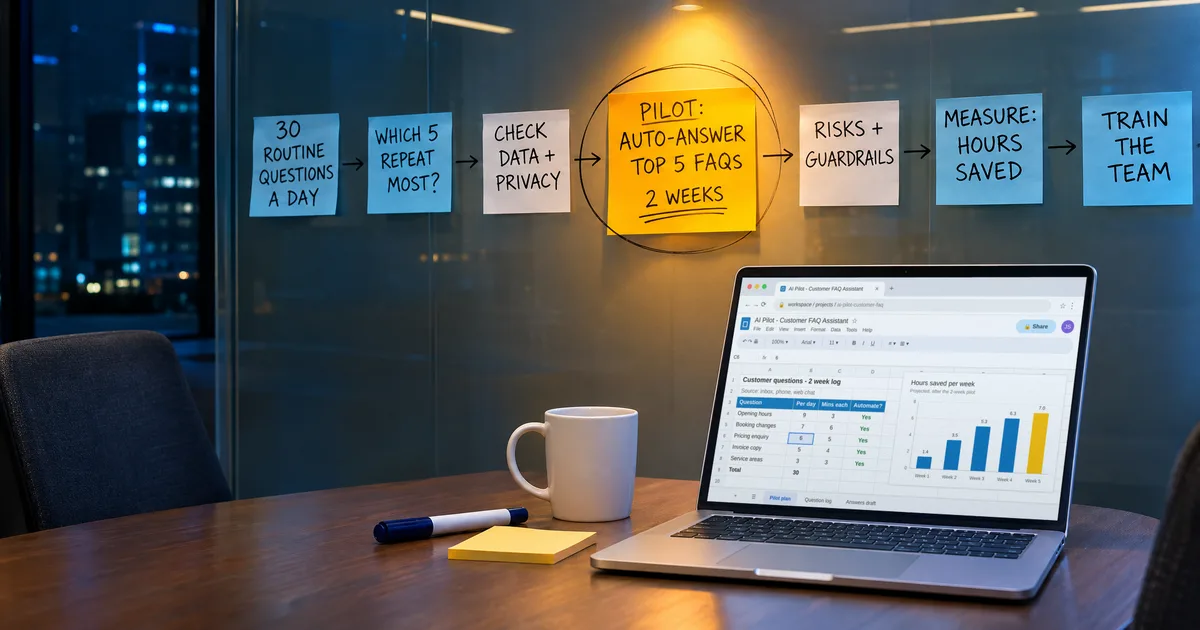
AI consulting is paid advice and hands-on help to decide where AI will pay off in your business, how to adopt it safely, and what to build or buy first. In Australia, a good AI consultant starts with your business problem rather than a tool, checks your data and privacy position, runs a small pilot with a measurable result, and leaves your team able to run it. Be wary of anyone who sells a platform before they understand the problem.
What AI consulting covers
- Strategy and prioritisation: finding the handful of tasks where AI saves real time or wins real revenue, and ranking them by effort and payoff.
- Readiness assessment: checking your data, systems, skills and processes. Our free AI readiness assessment is a quick first look.
- Governance and risk: deciding who is accountable, what data can be used and how outputs are checked.
- Pilots and build: a small, time-boxed project that proves the idea, such as an AI agent that handles a routine workflow.
- Adoption and training: getting staff to use the result, because unused AI saves nothing.
Our strategic consulting work covers the first three, and our product engineering team covers the build.
AI consultant, AI agency or software vendor?
| Who | Best for | Watch out for |
|---|---|---|
| AI consultant or consultancy | Deciding what to do and in what order | Advice with no delivery, or a slide deck that never ships |
| AI development agency | Building and running a specific AI solution | Building what they know rather than what you need |
| Software vendor | A packaged tool that already fits your task | Advice that always ends in their product |
Many businesses need the first two together: a short piece of advice, then a pilot. If you are still weighing tools, start with our guide to the best AI tools for Australian businesses.
How AI consulting is priced
There is no standard rate card for AI consulting in Australia, and we have not found a reliable published average, so treat any single figure with caution. What you will see is a handful of pricing models:
- Fixed-fee assessment: a short, defined piece of work that ends in a written plan.
- Fixed-fee pilot: a small build with an agreed result and end date.
- Time and materials: hourly or daily rates, which suit open-ended work but need a cap.
- Retainer: a monthly fee for ongoing advice and delivery.
Ask for the price of the first step only. A good consultant can scope a small, fixed-price starting point and tell you what it will produce. For the cost of the build that often follows, see our guide to app development costs in Australia.
What responsible AI looks like in Australia
Australia has no single AI law, but it does have clear guidance, and a good consultant should work from it. The National AI Centre's Guidance for AI Adoption, released in October 2025, sets out six essential practices: decide who is accountable, understand impacts and plan accordingly, measure and manage risks, share essential information, test and monitor, and maintain human control. It condenses the earlier Voluntary AI Safety Standard and has a short Foundations version for organisations just starting out.
Privacy is the other anchor. The Office of the Australian Information Commissioner released guidance on privacy and the use of commercially available AI products in October 2024. It advises, as best practice, against entering personal information, especially sensitive information, into public generative AI tools, and it asks organisations to check that a product is suitable before they adopt it. Ask any consultant how they would handle your customer data.
Eight questions to ask before you hire
- What will you recommend if the answer is "do not use AI here"? Honest consultants say no when it is the right answer.
- Which comparable businesses have you helped, and what changed? Ask for results you can check, not logos.
- Who does the work? Meet the person, not just the salesperson.
- What is the first step, what does it cost and what will I have at the end?
- How do you handle our data and privacy obligations? Listen for specifics.
- How will we measure success? Agree one number before work starts, such as hours saved or enquiries answered.
- Will you recommend tools you are paid to sell? Ask about commissions and partnerships.
- What happens when you leave? Your team should be able to run it, and you should own the work.
Red flags
- Promises of fixed savings or revenue before they have looked at your business.
- A tool chosen before the problem is understood.
- No plan for data, privacy or checking the AI's output.
- A long engagement with no early, measurable result.
- Terms that leave the code, prompts or accounts in their hands.
A worked example (illustrative, not a client result)
Imagine a 25-person services firm that answers the same 30 questions every day by phone and email. A sensible first engagement is a short assessment that lists those questions, checks what data an AI would need and flags the privacy points. The pilot then automates answers to the five most common questions, with a person reviewing anything unusual. Success is a single number agreed up front, for example the share of routine questions answered without staff time. If it works, the next five questions follow. If it does not, the firm has spent a small, fixed amount to find out. Our guide on why AI agent projects fail explains the common traps.
Where to start
Write down the three tasks that cost your team the most time, take our free AI readiness assessment, then book a conversation with a short list of consultants and compare their first-step proposals. If you want a second opinion on a proposal you already hold, talk to us.
Key takeaways
- AI consulting should start with a business problem, not a tool.
- There is no standard rate card, so ask for the price of a small first step with a written result.
- Look for work grounded in the National AI Centre's six practices and the privacy regulator's guidance.
- Agree one success number before any pilot starts.
- Make sure your team can run the result, and that you own it.
Common questions
What does an AI consultant do?
An AI consultant helps a business decide where AI will pay off, checks readiness and risk, and often runs a small pilot. A good one starts with a business problem, measures a result and leaves your team able to run what was built.
How much does AI consulting cost in Australia?
There is no standard rate card and no reliable published average. Work is usually priced as a fixed-fee assessment, a fixed-fee pilot, time and materials or a monthly retainer. Ask for the price of the first step only, with a written result.
Do I need an AI consultant or an AI development agency?
Consultants help you decide what to do and in what order. Development agencies build and run the solution. Many businesses need a short piece of advice followed by a pilot, ideally from the same team.
Is there Australian guidance for adopting AI responsibly?
Yes. The National AI Centre released the Guidance for AI Adoption in October 2025. It sets out six practices: accountability, impact planning, risk management, sharing information, testing and monitoring, and human control. The privacy regulator also published guidance on commercially available AI products in October 2024.
Can I put customer information into public AI tools?
The Office of the Australian Information Commissioner advises, as a matter of best practice, against entering personal information, particularly sensitive information, into public generative AI tools. Check any tool's suitability before using it with customer data.
How do I know if my business is ready for AI?
Look at whether your data is organised, your processes are written down and one person owns the result. Our free AI readiness assessment gives a quick first view.