
Marketplace · Web & mobile
From security contractor to security marketplace
A traditional guarding business wanted to grow beyond the ceiling of small-business contracting. We rebuilt it as a two-sided marketplace, Guardbay, matching vetted guards to shifts and paying them the moment the shift ends.
The business we started with
Our client ran a security contracting firm, the kind of operation that grows one contract at a time, where every new venue means another roster to fill by phone. The founder was ambitious and had run into the ceiling that shape of business always hits: revenue only grows if headcount and hours grow with it.
What he saw more clearly than most was that his customers, major contractors, employers and venue managers, were all using a staffing process that had not meaningfully changed in decades. Shifts were filled by phone calls and favours. Nobody could see who was available, who was qualified, or who would actually turn up.
He came to us with a clear brief: the growth he wanted was not available inside a contracting business. He needed a platform business model.
What we found in discovery
Working through the opportunity with the founder, two problems turned out to be the same problem seen from opposite sides of the market:
- Guards wanted reliable access to shifts near them, at times that suited them, and to be paid promptly rather than weeks later.
- Employers and venue managers were permanently short of cover, and had no way to confirm a guard was vetted and qualified before the shift started.
Neither side could solve it alone, and the existing business sat in the middle taking phone calls. That is the classic shape of a marketplace opportunity: two groups who need each other, and an intermediary absorbing all the friction manually.
What we built
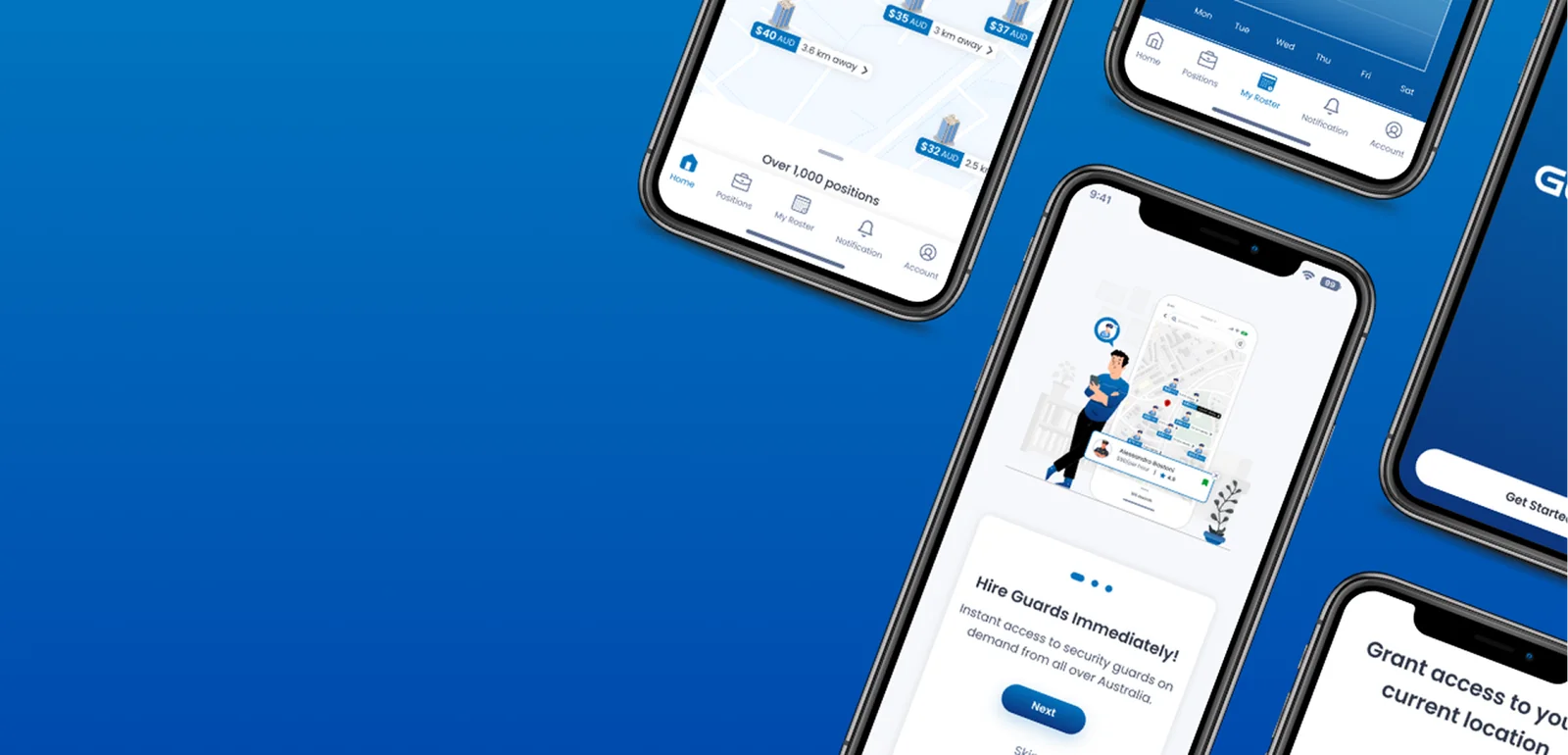
Guardbay is a two-sided marketplace, an Uber for security guards. Guards see the shifts available in the areas they work, apply for the ones that fit, and are paid at the end of the shift. Employers, venue managers and facility managers publish vacancies, find guards for a specific position, and know that anyone available has been vetted, is qualified, and will show up.
- Guard-side mobile app for discovering, applying for and completing shifts
- Employer-side tools for publishing vacancies and filling short-notice gaps
- Vetting and qualification held against each guard's profile, checked before a shift is accepted
- Payment released on shift completion rather than on a monthly billing cycle
Where it landed
The marketplace launched in Australia with international expansion planned. Early market testing was promising on both sides of the network, and the founder's original business changed shape completely, from a regional contractor constrained by the hours its staff could work, into a platform that scales with the number of guards and venues on it rather than the number of people it employs.
That is the difference the platform model makes to a valuation. A contracting business is priced on its earnings. A marketplace with network effects on both sides is priced on what those effects are worth as they compound.
Key takeaways
- The growth ceiling was in the business model, not in the execution.
- Both sides of the market had a problem the intermediary was absorbing by hand, the signature of a marketplace opportunity.
- Vetting and instant payment were not features; they were the reasons each side would trust the platform.
- The founder moved from competing inside an industry to operating the infrastructure underneath it.