
We work with your teams to bring an innovation mindset and challenge existing processes and frameworks of how you innovate and create
digital product solutions for your customers
The Rise of Agentic Workflows: Why Businesses Are Replacing Traditional Automation in 2026
Learn why agentic workflows are replacing traditional automation in 2026, and how AI agents help businesses work faster with safer, smarter processes.

Businesses have spent years automating work: sending reminders, moving data between systems, approving requests and producing reports. That still matters, but 2026 is seeing a shift. Companies now want software that can understand an objective, choose the next step, use the right tool and ask for help only when needed. This is where agentic workflows enter the picture.
Gartner has predicted that up to 40% of enterprise applications will include task-specific AI agents by 2026, compared with less than 5% in 2025. That explains why business leaders are no longer treating AI agents as a side experiment.
What are agentic workflows?
Agentic workflows are business processes run with AI agents that can plan, reason, act and adapt. A traditional workflow might follow a fixed path: if a form is submitted, send it to a manager. An agentic workflow can read the request, check records, decide whether details are missing and create a short summary.
| Traditional Automation | Agentic AI Automation |
|---|---|
| Follows fixed rules | Works towards a goal |
| Handles repeatable tasks | Handles multi-step work |
| Breaks when inputs change | Adjusts to context |
| Needs manual exception handling | Can triage many exceptions |
| Works inside set systems | Coordinates across tools |
Traditional automation is not disappearing. It still suits stable, high-volume tasks. The problem is that many processes are not neat. Customer queries vary. Invoices arrive in different formats. Staff requests lack detail. Sales leads need judgement. This is why agentic AI automation is gaining attention.
Why businesses are moving beyond old automation
The move from traditional automation to agentic systems is not just a technology upgrade. It reflects a broader change in work.
Businesses are replacing older automation because:
- Workflows now cross CRMs, finance systems, email, chat platforms and document stores.
- Rule-based bots struggle with messy information such as contracts, tickets and supplier emails.
- Teams want fewer handovers, not just faster handovers.
- Customers expect quicker, more personal answers.
- Managers need systems that explain what happened, not black-box shortcuts.
McKinsey has argued that companies get more value from agentic AI when they rebuild workflows around it, rather than placing agents on top of old processes.
Practical use cases across the business
The easiest way to understand agentic AI is to look at common work.
Customer service:
- Sorts tickets by urgency.
- Checks customer history before drafting replies.
- Escalates sensitive matters to a human.
Sales and marketing:
- Qualifies leads using public and internal data.
- Writes follow-up emails based on buyer behaviour.
- Updates CRM records after calls.
Finance, HR and operations:
- Reads invoices and flags missing information.
- Compares purchase orders with supplier records.
- Answers policy questions from staff.
- Helps schedule interviews and guide onboarding.
These examples show why agentic AI for business is less about replacing people and more about removing repetitive coordination.
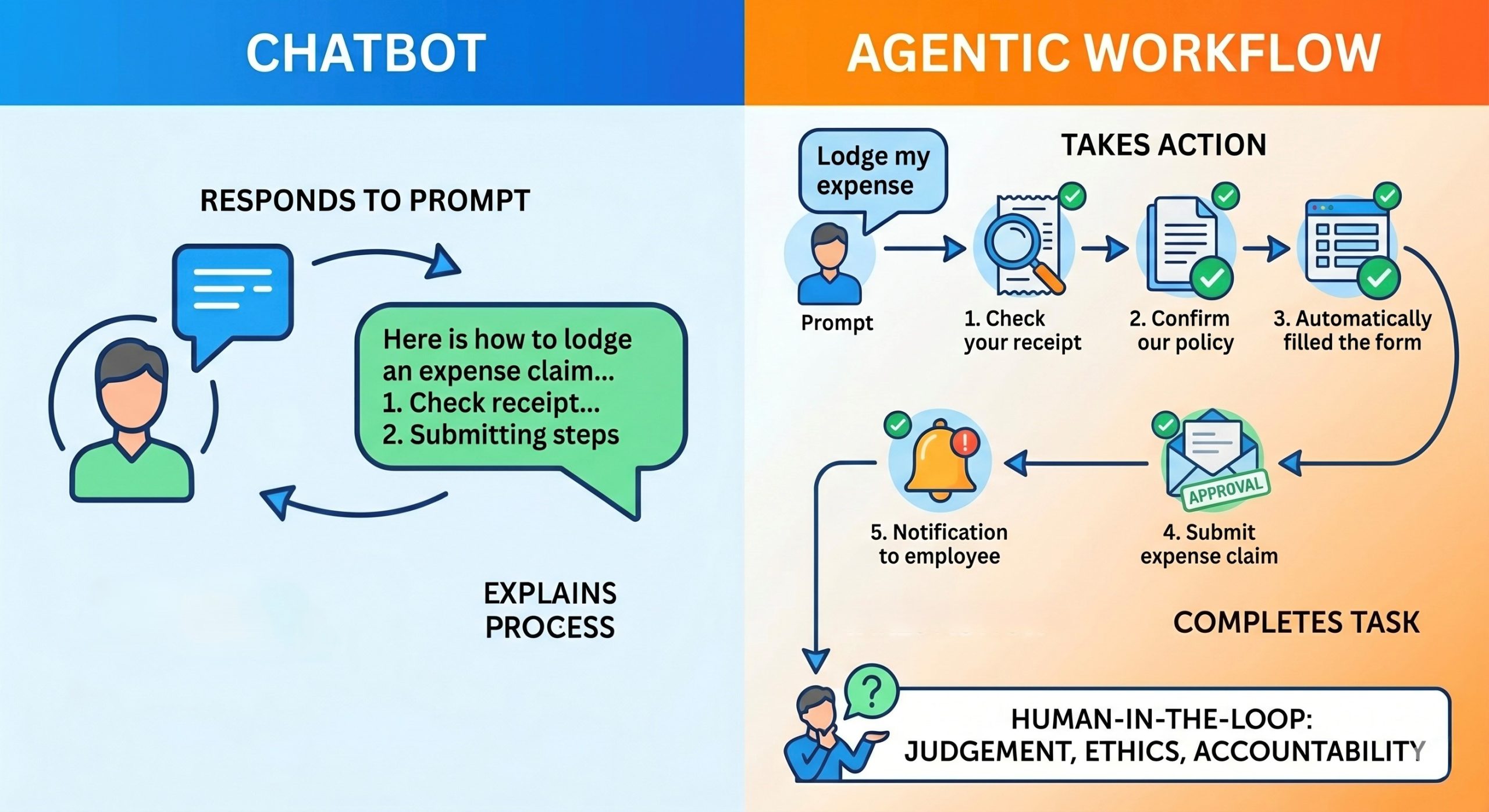
What makes agentic workflows different from chatbots?
A chatbot usually responds to a prompt. An AI agent inside a workflow can take action. For instance, a chatbot might explain how to lodge an expense claim. An agentic workflow could check the receipt, confirm the policy, fill out the claim, submit it for approval and notify the employee if something is missing. People remain involved where judgement, ethics or accountability are needed.
Governance matters. Gartner has warned that enterprise generative AI applications are likely to face more security incidents as adoption grows. When agents can access tools and data, businesses must treat identity, permissions and audit trails as part of the design.
Benefits, risks and limits
The benefits depend on the quality of the process and the guardrails around it. Common gains include:
- Faster turnaround times for requests, tickets and approvals.
- Lower manual effort in repetitive coordination tasks.
- Better use of existing data across systems.
- More consistent customer and employee experiences.
- Stronger visibility into bottlenecks and exceptions.
The less obvious benefit is that agentic workflows force businesses to ask what outcome they want. That question often exposes outdated steps, duplicated approvals and systems that no longer suit the team.
Still, businesses should not hand over sensitive decisions to AI without review. The right model is supervised autonomy: agents handle routine action, while people set policy, approve high-risk steps and check results.
Before adoption, teams should review data privacy, access permissions, approval points, error handling, audit logs, staff training and cost monitoring.
How businesses can prepare
A sensible rollout starts small. Pick one workflow with frequent delays, high manual effort and clear success measures. Map the steps, remove friction, then decide which actions an AI agent can safely perform.
Good first candidates include support triage, invoice checking, CRM updates, staff helpdesk requests and document-heavy approvals. Once the first workflow works well, businesses can expand to connected processes.
The future of automation is not a choice between people and machines. It is a move towards systems that carry more of the routine load while people focus on judgement and relationships.
Frequently Asked Questions:
What are agentic workflows?
Agentic workflows are AI-supported processes where software agents plan, act and adjust to complete business tasks. They differ from basic automation because they handle context, exceptions and multiple systems, not one fixed path.
How is agentic AI different from traditional automation?
Traditional automation follows pre-set instructions. Agentic AI can interpret a goal, gather information, choose actions and escalate issues when needed. This suits workflows with changing inputs, unstructured data or several decision points.
Why are businesses adopting agentic AI in 2026?
Businesses are adopting agentic AI because older automation often breaks when work becomes complex. AI agents can reduce handovers, speed up responses, improve data use and support flexible operations.
What are the best use cases for AI agents?
Common use cases include customer support triage, invoice processing, CRM updates, HR onboarding, IT ticket handling, compliance checks and sales follow-ups. The best starting point is a repeatable workflow with clear success measures.
Are agentic workflows safe for business use?
They can be safe when designed with strong controls. Businesses need access limits, human approval for sensitive decisions, monitoring, audit logs and clear escalation paths. The goal is controlled autonomy where it adds value.
Ready to move beyond basic automation? Explore how MVP1 can help your business design practical AI agent workflows that save time, reduce manual work and support better decisions.