
We work with your teams to bring an innovation mindset and challenge existing processes and frameworks of how you innovate and create
digital product solutions for your customers
Why Your Enterprise AI Strategy Matters More Than the AI Tools You Choose
Artificial intelligence is now a boardroom conversation. Business leaders are investing in chatbots, copilots, workflow automation platforms and AI agents in the hope of improving productivity, reducing costs and accelerating growth.

Introduction: Most AI Projects Don’t Fail Because of Technology
Artificial intelligence is now a boardroom conversation.
Business leaders are investing in chatbots, copilots, workflow automation platforms and AI agents in the hope of improving productivity, reducing costs and accelerating growth.
Yet many AI projects never move beyond experimentation.
The reason is rarely the technology itself.
It is usually the absence of a clear enterprise AI strategy.
Many organisations start by choosing tools. They compare models, purchase subscriptions and test automation platforms. The better question is simpler: how will AI create measurable business value?
A strong enterprise AI strategy aligns data, systems, workflows and people around a commercial objective. Without that foundation, businesses often accumulate disconnected tools that increase complexity instead of reducing it.
WhatsApp’s $19 billion acquisition by Facebook provides an important lesson. Facebook did not pay billions for messaging software. It invested in data, engagement, network effects and future intelligence opportunities.
The same principle applies today. Businesses that develop a clear enterprise AI strategy create a foundation for automation, operational intelligence and long-term competitive advantage.

Start with the Business Problem, Not the AI Tool
The biggest mistake organisations make is assuming AI is a technology project.
It is not.
It is a business transformation project.
A chatbot may answer customer questions.
An AI agent may automate an entire workflow.
A machine learning model may improve forecasting.
But none of those tools matter if they are solving the wrong problem.
Before investing in AI, business leaders should ask:
- What process is slowing growth?
- What manual work creates operational friction?
- Where are teams losing productivity?
- Which decisions rely on fragmented information?
- What customer experience issues affect retention?
A successful enterprise AI strategy begins with operational challenges rather than software features.
The goal is not AI adoption for its own sake.
The goal is creating measurable outcomes through AI business transformation.
Why Data Is the Foundation of Every Enterprise AI Strategy
Every AI system relies on data.
Without reliable information, even the most advanced models produce poor outcomes.
This is why a strong business data strategy often delivers more value than selecting a new AI platform.
AI systems learn from:
- Customer interactions
- Operational workflows
- Historical records
- Internal knowledge
- Business processes
The quality of those inputs directly affects the quality of the outputs.
A strong AI implementation strategy focuses on:
| Priority | Purpose |
| Data Quality | Improve reliability |
| Data Governance | Define ownership and control |
| Enterprise Data Management | Ensure consistency |
| Data Accessibility | Support automation |
| Security Controls | Protect sensitive information |
| Data Sovereignty | Maintain ownership |
Many businesses discover that their biggest AI challenge is not technology.
It is fragmented data.
Customer records live inside a CRM.
Documents sit in shared drives.
Knowledge exists in email inboxes.
Processes are spread across multiple systems.
Without a structured data management strategy, AI struggles to create meaningful value.
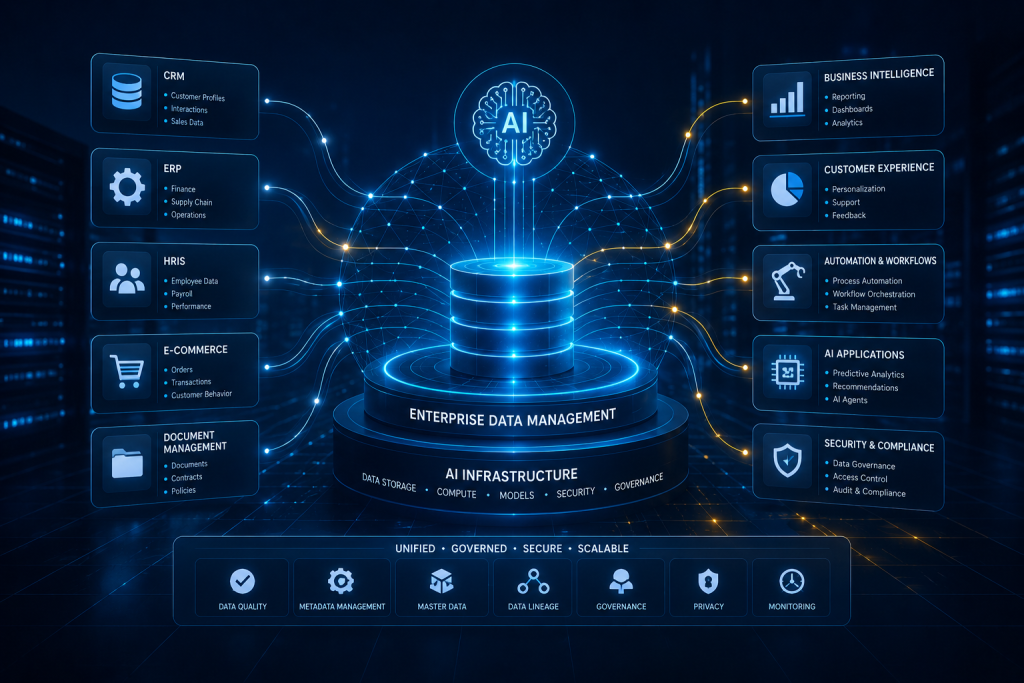
What WhatsApp Teaches Us About AI Competitive Advantage
When Facebook acquired WhatsApp in 2014, many questioned the valuation.
The company generated relatively modest revenue.
Its team was small.
Traditional financial metrics did not justify the acquisition.
However, Facebook saw something else.
Data.
Every message, interaction and engagement signal generated information.
That information created insight.
Those insights created opportunities.
This highlights a critical principle for modern businesses:
A company’s future value increasingly depends on its ability to generate, organise and apply intelligence.
Today, organisations compete on:
- Speed of decision-making
- Customer understanding
- Workflow efficiency
- Automation capability
- Platform scalability
All of these depend on information.
A strong enterprise AI strategy transforms data into business intelligence and eventually into an AI competitive advantage.
The companies winning with AI are not necessarily using better tools.
They are using better data.
The Difference Between AI Adoption and AI Operationalisation
Many businesses proudly announce AI initiatives.
Few achieve widespread adoption.
Why?
Because there is a difference between experimentation and operationalisation.
Experimentation focuses on tools.
Operationalisation focuses on workflows.
Consider two businesses.
Business A
- Purchases AI subscriptions
- Tests chatbots
- Experiments with prompts
- Runs isolated pilots
Business B
- Maps workflows
- Identifies bottlenecks
- Improves data quality
- Deploys automation against measurable objectives
Business B is practising AI operationalisation.
The result is sustainable value creation.
An effective AI adoption program should answer:
- Which workflows should be automated?
- Which systems require integration?
- What data sources are needed?
- What approval points should exist?
- Who owns performance after launch?
These questions matter more than model selection.
Why AI Agents Depend on Strong Foundations
The rise of AI agents has created enormous excitement.
Many organisations view agents as the next evolution of automation.
In many cases, they are right.
However, agents amplify existing business conditions.
Good data becomes more valuable.
Poor processes become more visible.
An AI agent supporting customer service might:
- Retrieve customer records
- Access internal knowledge
- Generate responses
- Escalate issues
- Update CRM systems
An agent supporting sales operations may:
- Qualify leads
- Generate proposals
- Schedule meetings
- Update opportunities
- Produce reports
These capabilities depend on:
- Reliable data
- Defined workflows
- Secure access
- Governance controls
Without those foundations, even advanced AI automation projects struggle.
A successful enterprise AI strategy prepares the organisation before deploying AI agents.
Data Sovereignty Is Becoming a Competitive Requirement
As AI adoption accelerates, business leaders are asking harder questions.
Where is our information stored?
Who owns the data?
Can external providers access our intellectual property?
What happens if regulations change?
This is where data sovereignty becomes increasingly important.
Many public AI platforms provide convenience.
However, convenience and control are not always the same thing.
Businesses handling sensitive information should evaluate:
- Data residency
- User permissions
- Auditability
- Compliance obligations
- Model governance
This is why many organisations are exploring private AI infrastructure rather than relying exclusively on public AI services.
Private environments provide greater control over:
- Proprietary information
- Customer records
- Internal processes
- Operational data
A mature enterprise AI strategy includes both innovation and governance.
Why Operational Intelligence Creates Long-Term Value
Many organisations view AI as another software category.
The more successful organisations view AI differently.
They view it as an intelligence layer.
This is the concept behind operational intelligence.
Operational intelligence combines:
- Data
- Workflows
- Automation
- Decision support
- Human oversight
into a connected business system.
Rather than solving isolated tasks, businesses improve how information moves across the organisation.
Examples include:
Sales
- Lead scoring
- Opportunity prioritisation
- Forecasting
Operations
- Resource planning
- Workflow monitoring
- Capacity management
Customer Service
- Case triage
- Knowledge retrieval
- Resolution support
Leadership
- Performance visibility
- Predictive insights
- Strategic planning
The result is a more responsive and scalable business.
This is where long-term AI competitive advantage emerges.
Not from tools.
From intelligence.
Four Questions Every Business Should Ask Before Investing in AI
Before approving another AI budget, ask:
1. Is our data ready?
Poor data creates poor outcomes.
2. Do we have a clear business objective?
AI should support measurable commercial goals.
3. Are governance controls defined?
Strong data governance reduces risk and improves trust.
4. Can the solution scale?
A successful enterprise AI strategy should support future growth rather than create technical debt.
These questions often reveal more value than evaluating another AI platform.
Key Takeaways
- A strong enterprise AI strategy creates business value long before tools are selected.
- Business data strategy and enterprise data management are foundational to AI success.
- AI agents perform best when supported by quality data and defined workflows.
- Data sovereignty is becoming increasingly important as organisations adopt AI.
- Private AI infrastructure provides greater control over intellectual property and operational data.
- Operational intelligence enables businesses to connect information, automation and decision-making.
- Sustainable AI adoption requires governance, ownership and measurable outcomes.
- Long-term AI competitive advantage comes from intelligence systems, not software subscriptions.
FAQ
Why do so many enterprise AI projects fail to deliver ROI?
Most AI projects fail because organisations focus on tools before business outcomes. A successful enterprise AI strategy begins with clearly defined objectives, reliable data, workflow design and governance controls. When businesses deploy AI without addressing these foundations, adoption slows, outputs become inconsistent and expected productivity gains often fail to materialise.
How do I know if my business is ready for AI adoption?
AI readiness depends less on technical maturity and more on operational maturity. Organisations should assess their data quality, system integration capabilities, process documentation, governance frameworks and internal ownership before investing heavily in AI. A structured AI readiness assessment often identifies opportunities that deliver value faster than deploying new technology.
Should businesses prioritise AI agents or data infrastructure first?
In most cases, businesses should strengthen their data foundations before scaling AI agents. Agents rely on access to accurate information, workflow context and connected systems. Without a strong business data strategy and appropriate AI infrastructure, even sophisticated agents can create inconsistent outcomes and additional operational risk.
What role does data sovereignty play in enterprise AI?
As organisations increase their use of AI, concerns around privacy, compliance and intellectual property become more important. Data sovereignty helps businesses maintain control over where information is stored, processed and accessed. For organisations handling sensitive customer, financial or operational data, data sovereignty is often a strategic consideration rather than simply a technical requirement.
How can AI create a competitive advantage without replacing employees?
The most successful AI initiatives augment people rather than replace them. AI can reduce repetitive work, surface insights faster and improve decision-making, allowing teams to focus on higher-value activities. A strong enterprise AI strategy combines human expertise with automation to create a sustainable AI competitive advantage rather than pursuing workforce reduction as the primary objective.
What is the difference between AI experimentation and AI operationalisation?
AI experimentation focuses on testing tools, models and use cases. AI operationalisation focuses on embedding AI into everyday workflows with clear ownership, governance and performance measurement. Many organisations experiment with AI, but only those that operationalise it achieve scalable business outcomes.
How should executives evaluate the success of an enterprise AI strategy?
Success should be measured against business outcomes rather than technical metrics. Common indicators include reduced operational costs, improved productivity, faster service delivery, higher customer satisfaction, increased revenue opportunities and better decision-making. A mature enterprise AI strategy should demonstrate measurable commercial value rather than simply increasing AI usage.
What should be included in an AI implementation roadmap?
A practical AI implementation roadmap should include data assessment, governance planning, workflow prioritisation, integration requirements, security controls, testing frameworks, adoption plans and performance measurement. Businesses that follow a structured roadmap are typically better positioned to scale AI initiatives while managing risk and maintaining operational control.
Choose the Strategy Before the Software
Technology will continue to evolve.
New models will emerge.
New platforms will enter the market.
The organisations that succeed will not necessarily be those using the newest tools. They will be the businesses with the strongest enterprise AI strategy, the clearest AI implementation roadmap, and the most disciplined approach to data governance and AI readiness.
Actionable Next Steps
- Audit where critical business data currently resides.
- Identify repetitive workflows suitable for business process automation.
- Assess current levels of AI readiness across teams and systems.
- Review governance controls for security, compliance and ownership.
- Prioritise opportunities that support measurable business outcomes.
- Build a phased AI implementation strategy rather than pursuing disconnected AI projects.
If your organisation is exploring AI business transformation, evaluating AI infrastructure, or planning a long-term enterprise AI strategy, the first step is understanding whether your data, systems and workflows are ready to support automation at scale.
At MVP1, we help organisations design private AI infrastructure, establish data governance frameworks, deploy AI agents, and build the foundations for sustainable operational intelligence. Whether you’re assessing AI adoption, creating a digital transformation strategy, or developing an AI implementation roadmap, our team can help identify the highest-value opportunities before significant investment is made.
Contact us or book a discovery call to assess your current enterprise AI strategy and discover how your data can become a long-term competitive advantage rather than an untapped business asset