
We work with your teams to bring an innovation mindset and challenge existing processes and frameworks of how you innovate and create
digital product solutions for your customers
Custom Software Development for Growing Businesses: When to Build, Buy or Stabilise
Learn when growing businesses should build custom software, buy off-the-shelf tools or stabilise an existing platform before committing budget and time.
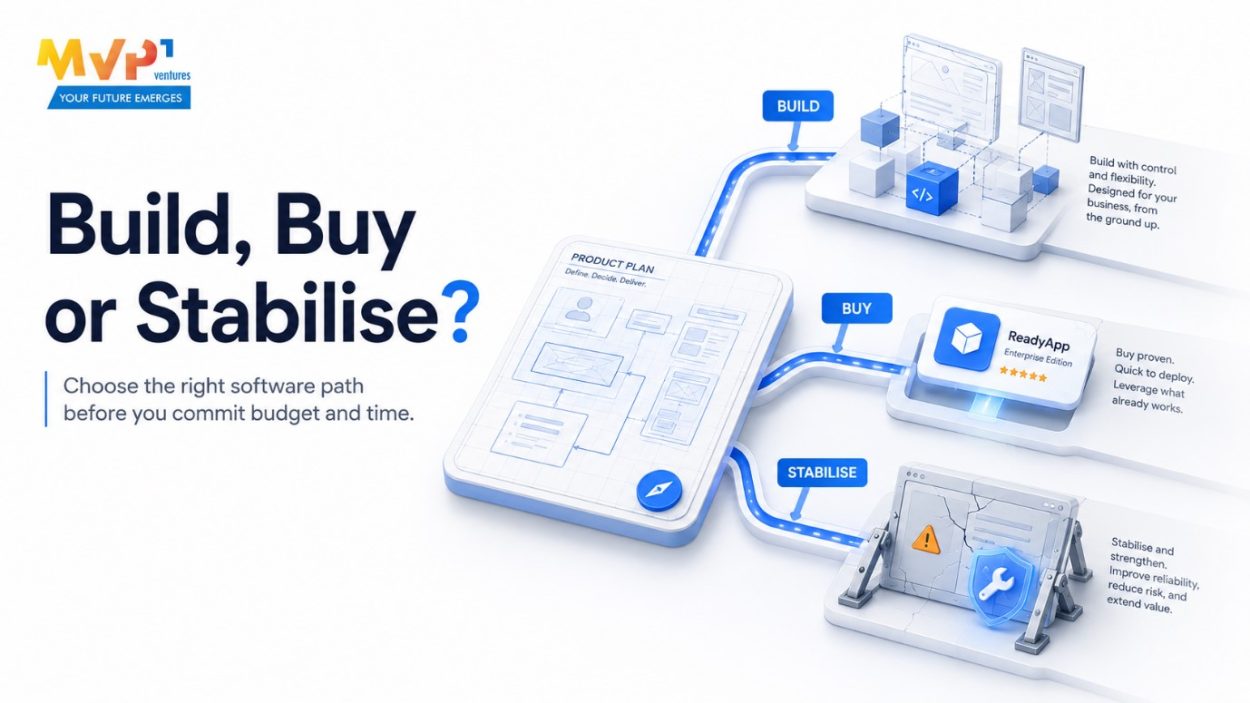
Most software decisions go wrong before a single line of code is written. A team commits to building when a ready-made tool would have done the job. Another buys a platform that can’t bend to how the business works. A third keeps patching a product that needed a structural fix months ago. The technology is rarely the problem; the decision about which path to take usually is.
For a growing business, that decision carries real money and time. Get it wrong and you pay in rework, stalled sales, rising hosting bills or an investor conversation that stalls. The useful question isn’t “should we build something?” It’s whether to build, buy or stabilise what you already have.
The decision is commercial before it’s technical
Build, buy and stabilise are often framed as engineering choices. They aren’t. Each is a bet on where your business is heading and how fast. Building buys control at the cost of time and ongoing ownership. Buying buys speed at the cost of fit. Stabilising protects what’s already in your codebase, once you understand what’s failing.
A clear way to start is to separate the workflow from the tool. Map how work moves through your business, then ask whether that workflow is common enough that someone has already built for it, specific enough to need a custom build, or already built but underperforming.

When a custom build earns its cost
Custom makes sense when the workflow is core to how you compete and no off-the-shelf product fits without awkward compromise. A marketplace with unusual supply-and-demand logic, an internal tool that encodes a process competitors can’t copy, or an AI product built on your own data are reasonable cases to build.
The mistake is treating a build as a one-off purchase. Custom software is owned, not bought. It needs maintenance, security planning, testing and someone accountable after launch. Priced over years rather than months, the real cost is higher than most first estimates suggest.
This is where AI agent development belongs in the conversation. An agent that handles support triage, lead prospecting or onboarding can remove repetitive load, but only where the workflow is clear, the data is reliable and the handoff to a human is defined. AI agents work best on repeatable tasks with a person still responsible for anything carrying legal, financial, safety or customer risk. They aren’t staff replacements, and treating them that way is how automation projects quietly fail. Australia’s national guidance on responsible AI adoption is a sensible reference before committing.
At MVP1 Ventures, we bring product managers, analysts, designers, developers, automation engineers and strategy consultants together to design, build, test and scale custom software development projects, AI agents and SaaS platforms. That mix keeps the build decision commercial, not just a technical brief handed to coders.
When buying off-the-shelf is the smarter move
Plenty of workflows are common enough that buying wins easily. Accounting, email, payroll, CRM, scheduling and basic reporting are solved problems. Building your own version of a mature category is rarely worth the cost unless the tool is itself your product.
Buying has its own trap. A cheap subscription can hide a poor fit that forces your team to reshape good processes around a rigid product. The honest test is whether the tool serves the workflow you need or quietly rewrites it. For many teams, the sensible pattern is to buy the common layer and build only where you genuinely differ.
The third option most teams miss: stabilise what you have
Build versus buy is a false choice for many growing businesses, because the product already exists. It was built, it shipped, and now it strains under real use. The right move isn’t a fresh build or a new vendor. It’s a structural fix.
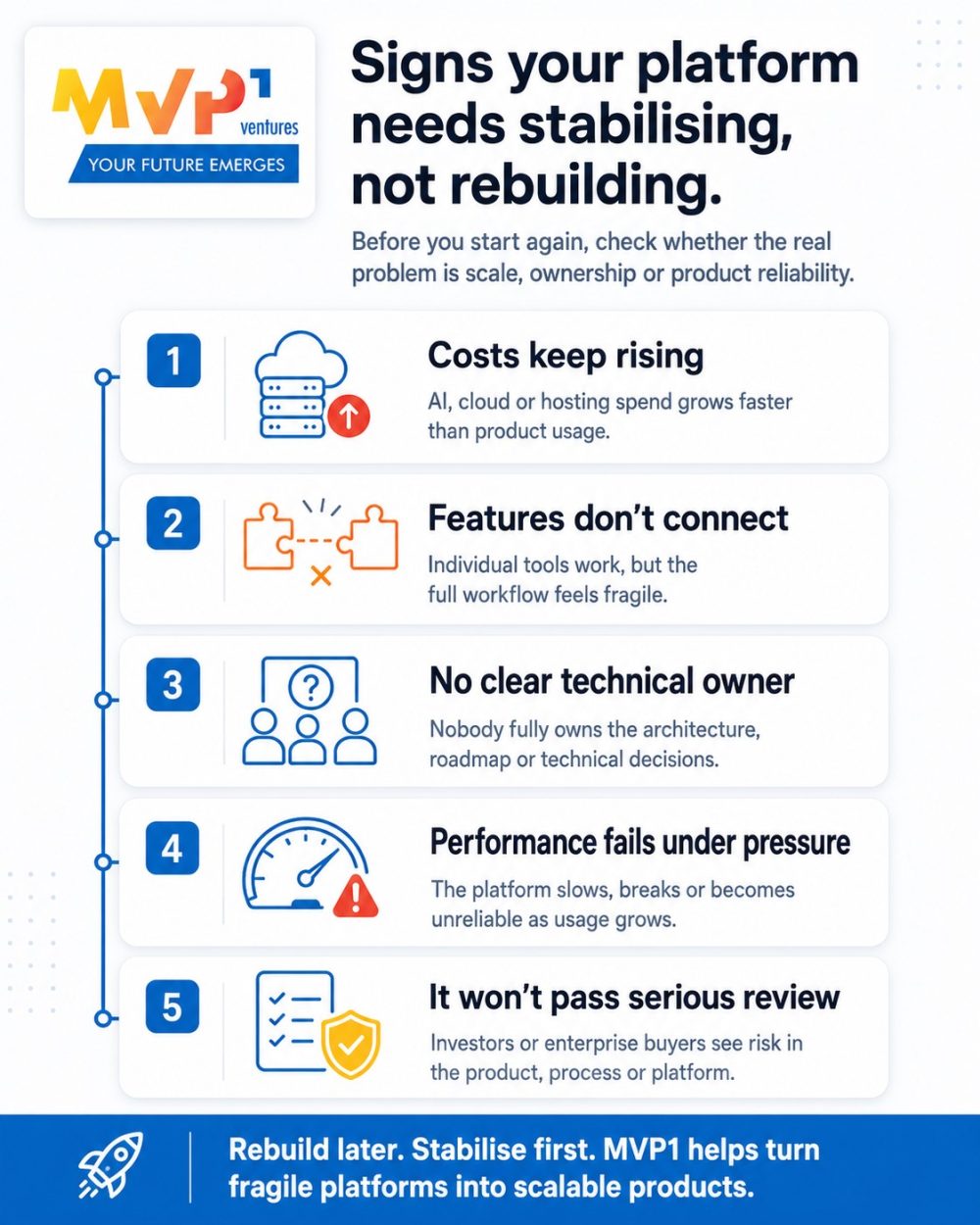
We see the same pattern often. Six figures spent across several developers, no clear ownership, features that work alone but not as a system, unpredictable performance, and AI costs rising with no path to scale. A product can technically exist and still fail commercially. If it can’t scale, sell or raise capital, it isn’t finished.
A stabilisation project should start with diagnosis, not code. Before changing anything, the team needs to understand the architecture, infrastructure, integrations, performance, security and the commercial goals the product serves. The fix might be re-architecture, cost control on inefficient AI usage, or clearer product ownership. The right path depends on what’s failing, and a rebuild isn’t automatically the answer.
At MVP1 Ventures, our platform stabilisation work runs through our ScaleReady framework, which takes existing AI products and platforms from fragile toward fundable. We assess what’s built, find the technical and commercial blockers, then plan the work that supports growth and any future investment discussion.
How to choose without guessing
Be honest about three things: how specific your workflow is, how mature your product already is, and the commercial goal for the next twelve to eighteen months. Those answers usually rule out one or two options on their own.
| Path | Best when | Main cost | Watch out for |
|---|---|---|---|
| Build | The workflow is core, specific and a real edge | Time, budget, ongoing ownership | Pricing it as a one-off, not a multi-year commitment |
| Buy | The workflow is common and well served | Fit and flexibility | Reshaping good processes around a rigid tool |
| Stabilise | The product exists but won’t scale, perform or sell | Diagnosis before fixes | Assuming a rebuild, or that an audit alone solves it |
If you’re early and still testing whether the idea holds up, none of these may be the first step. Shaping the problem, customer, pricing and value model often matters more than the build. That’s the thinking behind our early-stage Accelerate Program, which helps founders pressure-test a concept before a larger spend.
Frequently asked questions
How do I know if my software needs rebuilding or just stabilising?
Start with a diagnosis rather than an assumption. Many platforms that feel broken have fixable architecture, cost or ownership problems rather than fundamental flaws. A review of architecture, performance and commercial goals usually shows whether targeted fixes will do.
Is custom software always more expensive than buying a tool?
Upfront, almost always. Over time, it depends. A custom build carries maintenance, security and ownership costs that a subscription absorbs for you. Custom tends to pay off only where the workflow is core to how you compete.
Are AI agents a safe way to cut costs?
They can help, but not automatically. AI agents return value on repeatable workflows with reliable data and clear human review points. They aren’t suited to sensitive legal, financial or compliance decisions without oversight, so the saving depends on the workflow you choose.
Work out the right path before you commit
If your team is weighing whether to build, buy an off-the-shelf tool, or fix a platform that already exists, the safest first step is to assess where you stand. We help founders and business leaders make that call with commercial and technical evidence. Book a discovery call with our team and we’ll help you decide whether to build, buy or stabilise.