
We work with your teams to bring an innovation mindset and challenge existing processes and frameworks of how you innovate and create
digital product solutions for your customers
AI Agents vs Chatbots: What Business Leaders Need to Understand Before Automating Workflows
Chatbots answer. AI agents act. Here is how business leaders can tell them apart and pick the right one before automating any workflow.
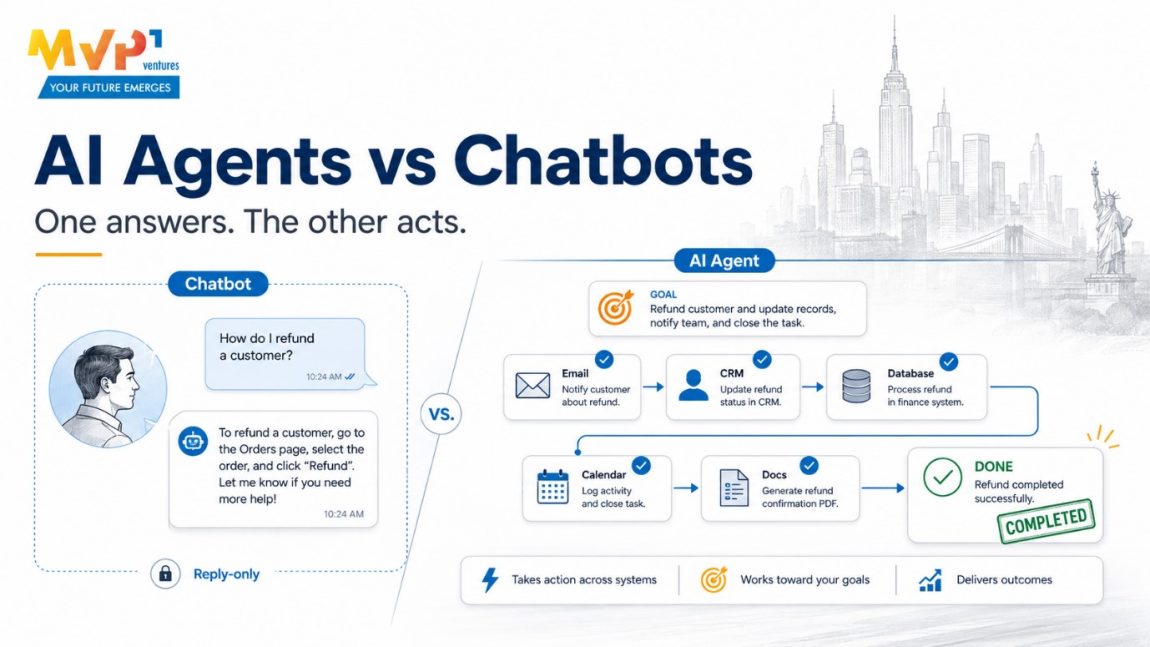
A logistics manager in Brisbane switched on her new “smart assistant” expecting it to chase late suppliers, update the system, and flag the orders at risk. It did none of that. It answered questions about late suppliers. Politely. All day. When she finally asked it to reschedule a delivery, it gave her a phone number.
That gap, between a tool that talks and a tool that acts, is where most automation budgets quietly disappear.
One answers. The other acts.
Start with the thing everyone already knows. A chatbot is a conversational front door. You type or speak, it responds, and the whole exchange lives inside one turn or a short scripted sequence. Customer service bots, FAQ widgets, the little helper that walks you through a password reset. Bounded, predictable, fine at what it does.
AI agents are a different animal. They don’t just reply. An agent takes a goal, makes a plan, calls other systems to get things done, checks the result, and adjusts. Memory, tools, and a loop. Where a chatbot recites the refund policy, an agent reads the order, confirms the customer is eligible, issues the refund, and sends the email. One holds a conversation. The other finishes a job.
Which one suits the job
So which do you actually need? Match the tool to the shape of the work.
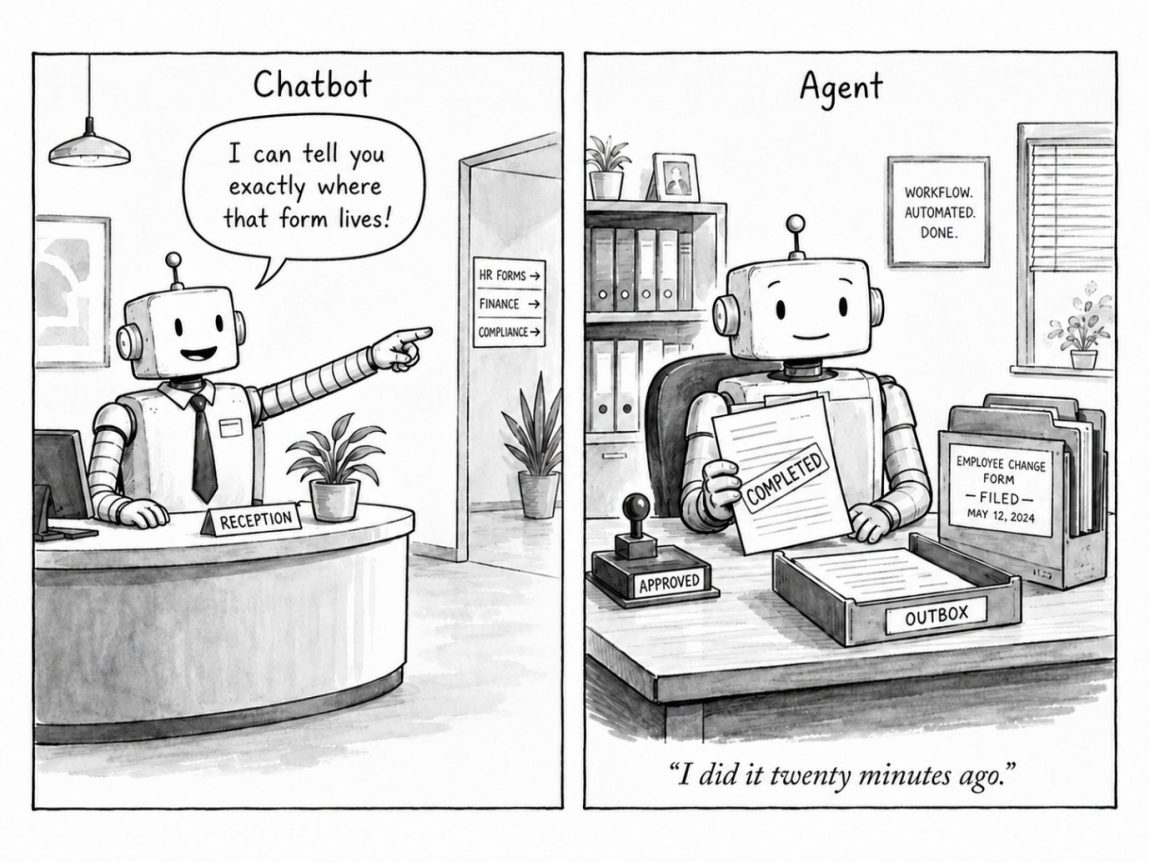
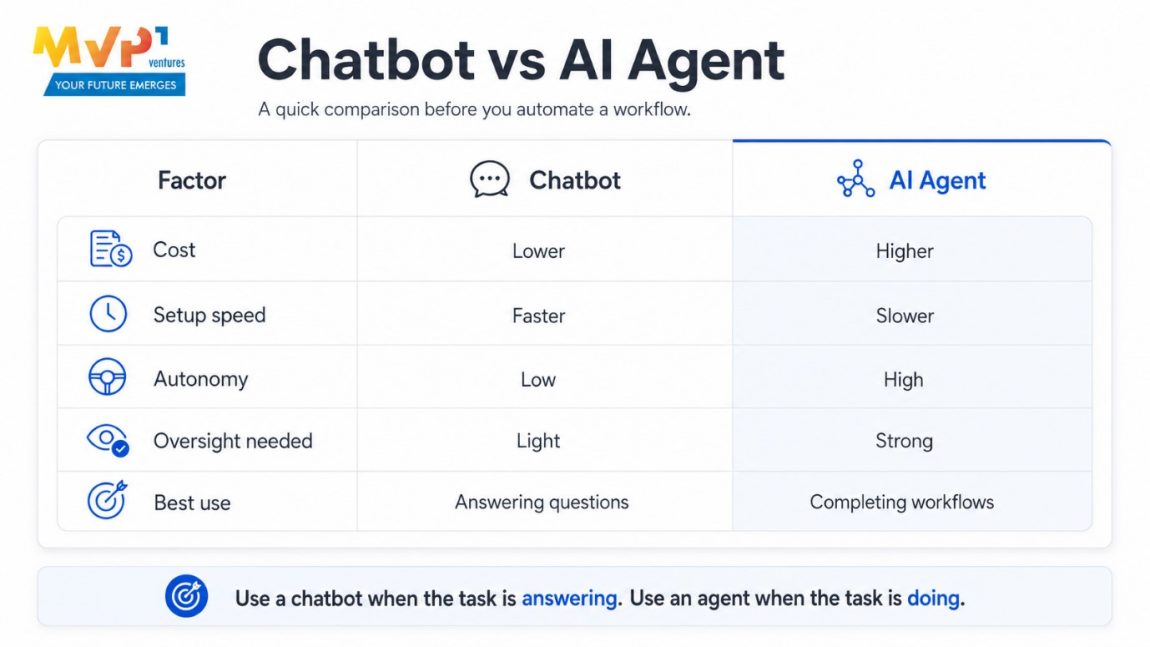
Reach for a chatbot when the work is answering. Frequently asked questions, opening-hours queries, first-line support triage, catching a lead and passing it along. The task is bounded, the answers are knowable, and a wrong reply is low stakes. A chatbot here is cheap, quick to stand up, and easy to predict. Set it up, let it field the same fifty questions it will field again tomorrow, and move on. The ceiling is low, but so is the cost of hitting it.
Reach for an agent when the work is doing, and the doing runs across several steps and several systems. A small business wants every lead qualified, enriched, scored, and dropped into the CRM with a follow-up already booked. A hospital back office wants patient records reconciled across three systems overnight. An early-stage software startup wants every trial sign-up greeted, onboarded, and nudged toward the one feature that makes people stay. A claims team wants the routine 80 per cent handled end to end, so staff can spend their hours on the hard 20. That’s workflow automation with judgement in the middle, and a scripted bot simply can’t carry it. An agent like that costs more and takes longer to build than a chatbot. It also does something a chatbot never will.
The trade-offs
Neither choice is free of regret.
Chatbots are inexpensive and reliable, and they stay in their lane, which is precisely the problem the moment a task grows past a single question. Push a chatbot to do real work and it breaks in plain sight.
Agents are powerful in a way that should make you slightly nervous. Because they act, their mistakes compound. A wrong answer from a chatbot annoys one customer. A wrong decision from an agent can set off a chain of actions across your systems before anyone notices. That power carries real bills, too, and real governance questions about what the agent can touch and what data it gets to see.
Oversight isn’t a one-off, either. An agent needs monitoring, logging, and someone accountable when it does something strange at two in the morning. That’s a running cost, not a launch cost, and it’s the line item most pilots forget. When a vendor pitches you an “agent,” the test is simple. Ask what it does without a human typing the next instruction. If the answer is “nothing,” you’re looking at a chatbot with better marketing.
The market data carries a warning worth reading twice. Gartner expects over 40 per cent of agentic AI projects to be scrapped by the end of 2027, blaming runaway costs, fuzzy value, and thin risk controls. The same analysts coined a handy term for the noise in the market, “agent washing,” the rebadging of ordinary chatbots as agents. Adoption keeps climbing all the same. PwC found four in five companies already running agents in some form. Both things are true at once. The technology works, and most of the failures are decisions, not code.
Before you automate anything
A few unglamorous decisions save the whole project.
Map the workflow first. A process that’s a mess on paper just becomes a faster mess once automated. Pick the tool to fit the risk: low stakes and bounded, a bot will do; multi-step and consequential, an agent earns its keep. Decide where a human stays in the loop, especially anywhere money moves or a customer feels the outcome. And settle the data question early. An agent that reaches into patient files, financial records, or contracts raises questions a procurement form won’t answer, which is why serious enterprise AI work now starts with governance and, more and more, private AI infrastructure that keeps sensitive data inside your own walls. Then start narrow. One workflow, measured against a number you already track, beats a grand rollout that nobody can evaluate six months in.
None of that is exciting. All of it is the difference between an agent that pays for itself and one that becomes next year’s cancelled project.
The takeaway
The answer to “agent or chatbot” is almost always “it depends on the job,” and the leaders who get value are the ones asking that question before they buy, not after. Buy a chatbot to do an agent’s job and it underdelivers in week one. Buy an agent to do a chatbot’s job and you’ve overspent on a glorified FAQ.
At MVP1, we build both, and we’ll tell you plainly when the cheaper one is all you need. If you’re weighing up automation and want a clear-eyed read on what actually suits your workflows, book a discovery call and we’ll map it out with you.