
We work with your teams to bring an innovation mindset and challenge existing processes and frameworks of how you innovate and create
digital product solutions for your customers
Why Most AI Agent Projects Fail in Production (And How Enterprise Teams Are Fixing It)
Learn why AI agent projects fail in production and how enterprise teams use workflow design, governance and managed rollout to make AI agents work.

AI agents can create real value when they are built around a business process, not a product demo. The trouble starts when a promising pilot moves into daily operations. Production brings live data, customers, staff habits, permissions, exceptions and commercial pressure. Gartner has warned that many agentic AI projects may be cancelled by 2027 because of rising costs, unclear value and weak risk controls. The lesson is not “avoid AI agents”. It is “build them properly”.
For MVP1, this is where the work begins: mapping workflows, testing return on investment, integrating tools, setting guardrails and keeping the system useful after launch.
What does it mean to run AI agents in production?
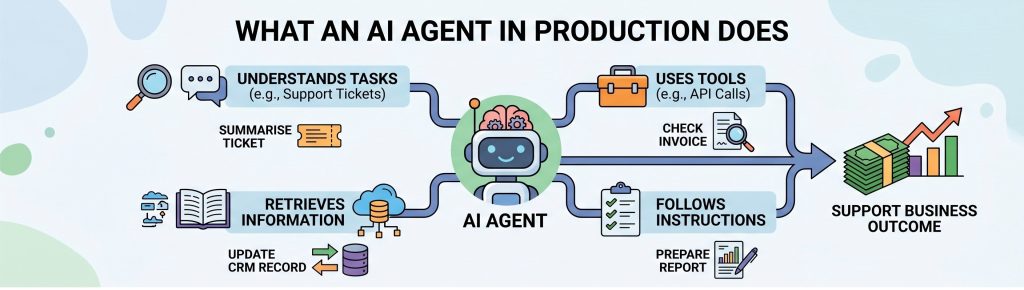
An AI agent in production is software that can understand a task, use tools, retrieve information, follow instructions and support a business outcome. It may summarise a support ticket, check an invoice, update a CRM record or prepare a report for review.
The production setting matters because the agent is no longer working with sample prompts. Enterprise AI agents need defined access, monitoring, testing, audit trails and support, because a small error can quickly become a business problem.
Why pilots look better than live systems
AI pilots often succeed because the test environment is controlled. The data is cleaner. The use case is narrow. Staff know what the agent is meant to do and step in when it struggles.
A live workflow is different. Customers ask unexpected questions. Internal systems do not always share data cleanly. A supplier changes a process. A policy gets updated. McKinsey’s State of AI research has found that organisations seeing stronger value from AI often redesign workflows and place senior leaders in governance roles. The model is only one part of the system. The way work is designed around it matters just as much.
The common reasons AI agent projects fail
Most production problems come from ordinary delivery gaps.
-
No clear owner: No one owns performance, risk, cost or improvement after launch.
-
Weak business case: The project starts with “we should use AI” rather than a clear workflow problem.
-
Poor system integration: The agent cannot reach the tools or data it needs.
-
Too much autonomy too early: The agent receives broad permission before it has proved itself.
-
Limited monitoring: Teams cannot see what the agent did or missed.
-
No review process: High-risk actions happen without human approval.
-
Agent sprawl: Separate agents create duplication and uneven quality.
Many projects fail because businesses treat agents like clever add-ons instead of managed operating systems.
How enterprise teams are fixing it
Start with one valuable workflow, then build around it carefully. A customer service team might use an agent to classify tickets, find order details and draft a response. The agent can save time without being allowed to send sensitive messages on its own.
Successful teams usually apply a few habits:
-
They choose a workflow with measurable value.
-
They limit what the agent can access.
-
They test real examples before launch.
-
They keep a person in the loop for risky steps.
-
They review logs and user feedback.
-
They improve prompts, tools and rules over time.
-
They measure cost against time saved, faster response and accuracy.
AI agents for business operations are strongest when they reduce repeat work inside support, finance, procurement, reporting, onboarding or administration. The goal is not to replace judgement. It is to remove avoidable friction so people can focus on work that needs context and care.
What a managed AI rollout should include
A production agent needs more than a model and a prompt. It needs a delivery model that covers strategy, build, integration, governance and support.
| Production Need | What it Protects |
|---|---|
| Workflow mapping | Prevents the agent from solving the wrong problem |
| Integration planning | Connects the agent to useful business tools |
| Access controls | Limits data and actions |
| Human approval | Adds review before sensitive decisions |
| Audit logs | Helps teams trace actions |
| Ongoing support | Keeps the agent aligned as the business changes |
This is also where an AI agent management platform or managed delivery layer becomes valuable. It gives teams a central way to track agent behaviour, improve performance and manage risk as use grows.
Production readiness checklist
Before launching an AI agent, ask:
-
What exact workflow will this agent support?
-
Who owns the result after launch?
-
What data can the agent access?
-
Which actions need human approval?
-
How will errors be reported?
-
How will ROI be measured?
-
Who reviews logs each month?
If these questions feel difficult, the project is probably not ready for production.
The real lesson for business leaders
AI agents are not failing because the idea is weak. They fail when businesses skip the operational work that makes software dependable. The winning teams are not simply building more agents. They are building clearer processes around them.
For growing Australian businesses, the opportunity is practical: find slow workflows, test where AI can help, integrate it with existing systems and manage it like a core business tool.
Frequently Asked Questions:
Why do AI agents fail in production?
AI agents fail in production when they lack workflow design, system access, monitoring, ownership and guardrails. A pilot may look strong because staff correct issues manually. Live use needs testing, logs, permissions and a clear support process.
How can a business deploy AI agents safely?
Start with a narrow workflow, limit permissions, test real cases and require human approval for risky actions. Safe deployment also needs audit logs, cost tracking, incident handling and regular review by both business and technical owners.
What are the best AI agent use cases for business operations?
Good use cases include customer support triage, invoice checks, internal knowledge search, procurement support, onboarding tasks and report preparation. These workflows are repeatable, measurable and often slow teams down when handled manually.
How do you measure AI agent ROI?
Measure time saved, fewer manual steps, faster response times, reduced errors, staff capacity and customer impact. Compare those gains with setup, model, hosting, integration and support costs. ROI should be checked before and after launch.
Do AI agents need human oversight?
Yes. Human oversight is especially important for financial, legal, customer-facing or sensitive data tasks. People should approve high-risk actions.
Ready to move your AI agents from pilot to production with less risk and clearer ROI? Book an MVP1 AI Agent Strategy Call to map your first workflow, prioritise automation opportunities and build a rollout plan around your existing systems.